A European Microsoft 365 alternative: what decision makers should check
Data location, legal situation, feature coverage, migration and Outlook: what matters when choosing a European alternative to Microsoft 365 – and where Microsoft is ahead.
Organisations looking for a European Microsoft 365 alternative rarely have a single problem. They usually face several questions at once: where does our data live, which jurisdiction does the provider fall under, does the alternative actually cover how we work – and how do we get there without disrupting the business? This article walks through the key checks, is honest about where Microsoft is stronger, and shows what a step-by-step switch can look like. As of October 2026.
Why organisations look for a Microsoft 365 alternative
A frequent trigger is the US CLOUD Act. Under 18 U.S.C. § 2713, providers of communication and cloud services must disclose data in their possession, custody or control when ordered to – regardless of whether that data is stored inside or outside the United States.
A hearing in the French Senate on 10 June 2025 showed what this means in practice. Asked whether Microsoft could guarantee under oath that French citizens’ data would never be passed to US authorities without France’s consent, Microsoft France’s representative answered “Non, je ne peux pas le garantir” (“No, I cannot guarantee it”), adding that this had never happened so far (Senate record).
In February 2025 Microsoft completed its EU Data Boundary, under which, according to Microsoft, Microsoft 365 data of European customers is stored and processed in the EU and EFTA. That answers the question of where data is stored. Which law the provider is subject to is a separate question.
Legal situation: the EU-US Data Privacy Framework in October 2026
Since the adequacy decision of 10 July 2023 (Implementing Decision (EU) 2023/1795), personal data may be transferred to US companies certified under the EU-US Data Privacy Framework. The decision is under scrutiny:
- The EU General Court dismissed the action brought by French MP Philippe Latombe on 3 September 2025 (T-553/23). An appeal to the Court of Justice has been pending since 31 October 2025 (C-703/25 P).
- On 29 June 2026 the US Supreme Court ruled in Trump v. Slaughter that the President may remove members of the Federal Trade Commission (FTC) at will. In a letter dated 31 July 2026, the European Data Protection Board asked the Commission to closely assess the consequences, because the adequacy decision relies on the FTC’s independence.
- The organisation noyb has called on the Commission to withdraw the decision and announced its own annulment action (noyb, 29 June 2026).
Important for context: the decision remains in force until the Commission repeals it or the Court of Justice annuls it. For decision makers this mainly means planning uncertainty. If your collaboration depends on a service that relies on transfers to the US, you should know what happens if the framework falls.
Five checks for your selection
| Check | What to look for |
|---|---|
| Data location and jurisdiction | Where are the servers, where is the provider headquartered, which sub-processors are involved – including for office, video and AI features? |
| Feature coverage | Which tools does your team actually use: files, office, email, calendar, chat, video, tasks? A list of features you use is more useful than a comparison of every feature. |
| Open standards and exit | Can you reach your data through standard interfaces such as WebDAV, CalDAV and CardDAV? Plan the exit before you sign up. |
| Migration and coexistence | Does everything have to move on one cut-over date, or can the mailbox and Outlook stay for now? |
| Sign-in and administration | Can your existing identity provider (for example Microsoft Entra ID) be connected via single sign-on and SCIM? |
Test any alternative with real files and real workflows. Especially with complex spreadsheets or templates, only your own test shows whether browser-based editing is enough for your cases.
Where Microsoft 365 is stronger
A fair comparison includes this. Microsoft has a clear lead in several areas:
- Desktop apps: Microsoft 365 Business Standard and higher include the desktop versions of the Office apps (Microsoft Learn). If you work heavily with Excel models or Word templates, you get the full feature set there.
- Ecosystem and compliance tooling: Microsoft integrates Teams, SharePoint, Entra ID and Purview features such as data loss prevention and eDiscovery (Microsoft Learn).
- Mobile apps: Microsoft offers native apps for iOS and Android. nest54 runs in the browser; an installable app with push notifications is planned but not yet available.
- Attestations: Microsoft provides audit reports against the BSI C5 criteria catalogue (Microsoft Learn). For nest54, ISO 27001 and C5 are targets, not existing certifications.
For a side-by-side view, see nest54 vs. Microsoft 365.
Migration without a cut-over date: Outlook can stay
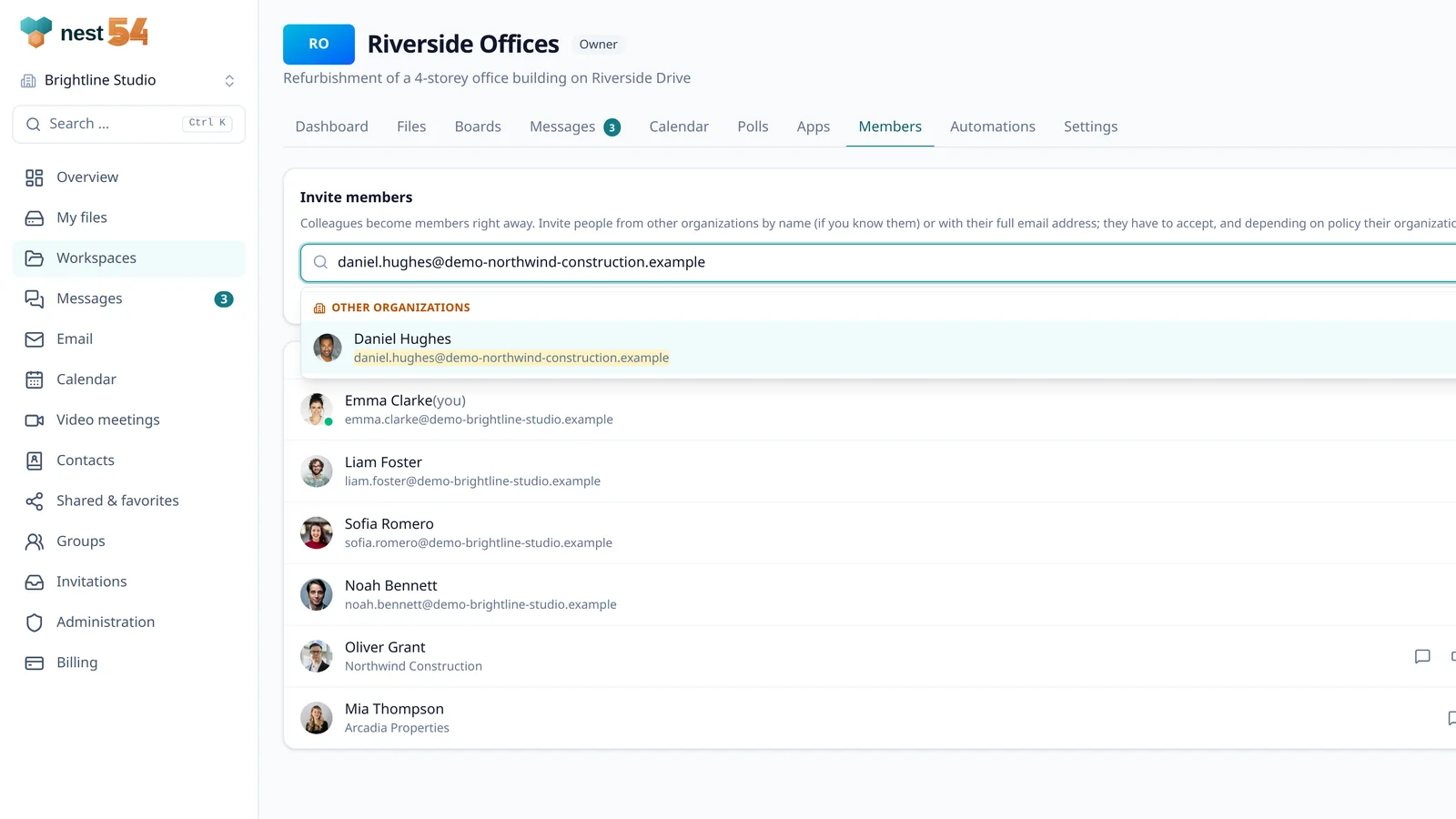
A switch doesn’t have to happen over one weekend. Many teams start with an area where the current setup causes friction – such as projects with external partners – and leave the mailbox and Outlook at Microsoft for now. nest54 connects to the Microsoft account for this: read and send email, and sync calendars and contacts in both directions. How that works in detail, and where the limits are, is covered in Keep using Outlook: connecting nest54 to Microsoft 365.
To move existing data, these routes are available today:
- Import calendars from .ics files and contacts from vCard or CSV (including Outlook exports).
- Upload files in the browser, or transfer them with the Windows app (files on demand) or via WebDAV.
To be honest: nest54 does not currently offer an automatic import from OneDrive or SharePoint. And as long as the mailbox stays at Microsoft, your email stays there too. Coexistence is an intermediate step, not a complete exit.
Where nest54 fits – and where it doesn’t
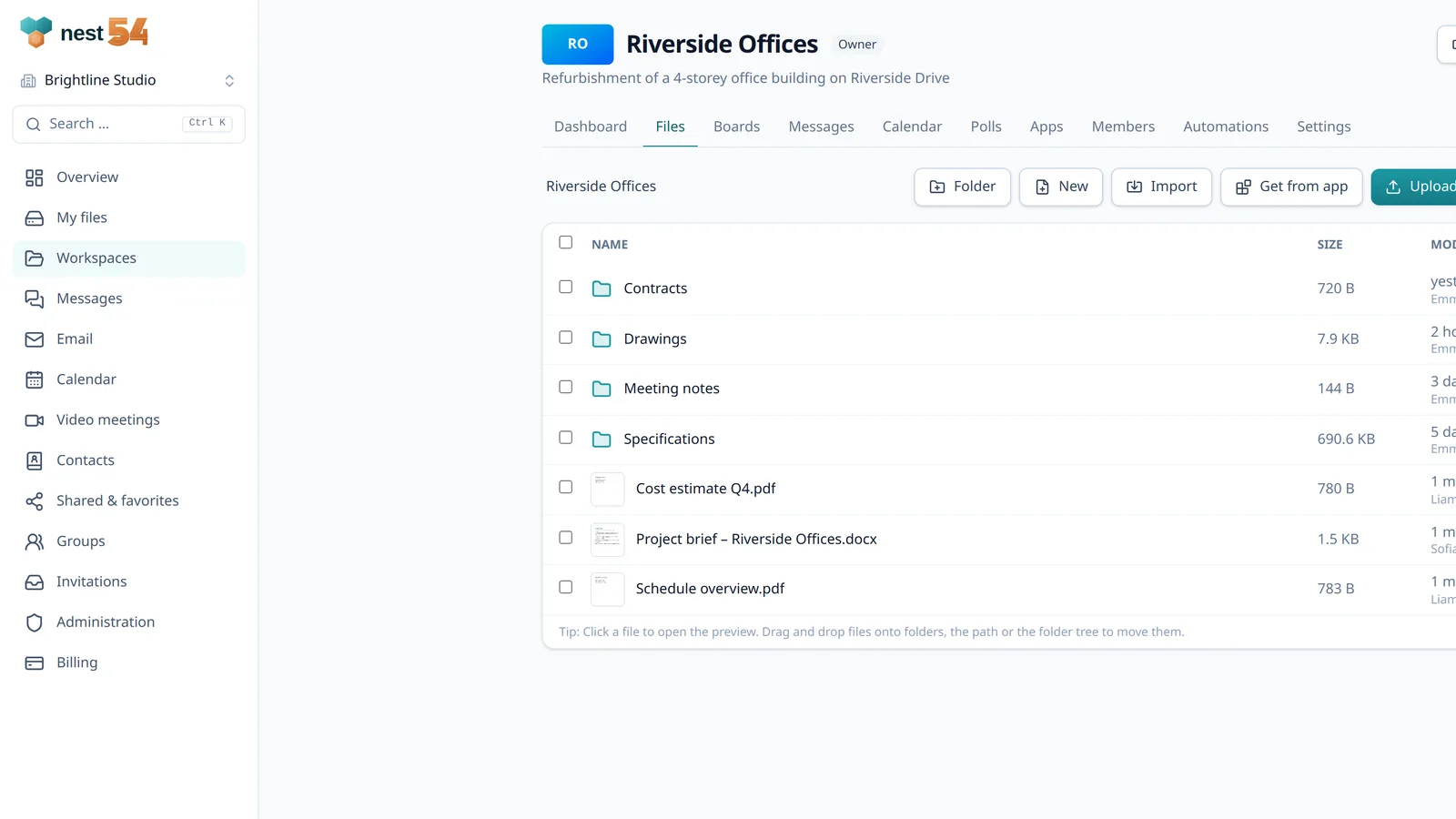
nest54 runs on servers in German data centres. Browser-based office, video meetings and speech recognition run on those servers. Files are encrypted with a separate key per organisation, and administrators sign the data processing agreement directly in the platform. The focus is on projects involving several organisations: clients and partners work in the same workspace, while the data stays with the organisation that created it.
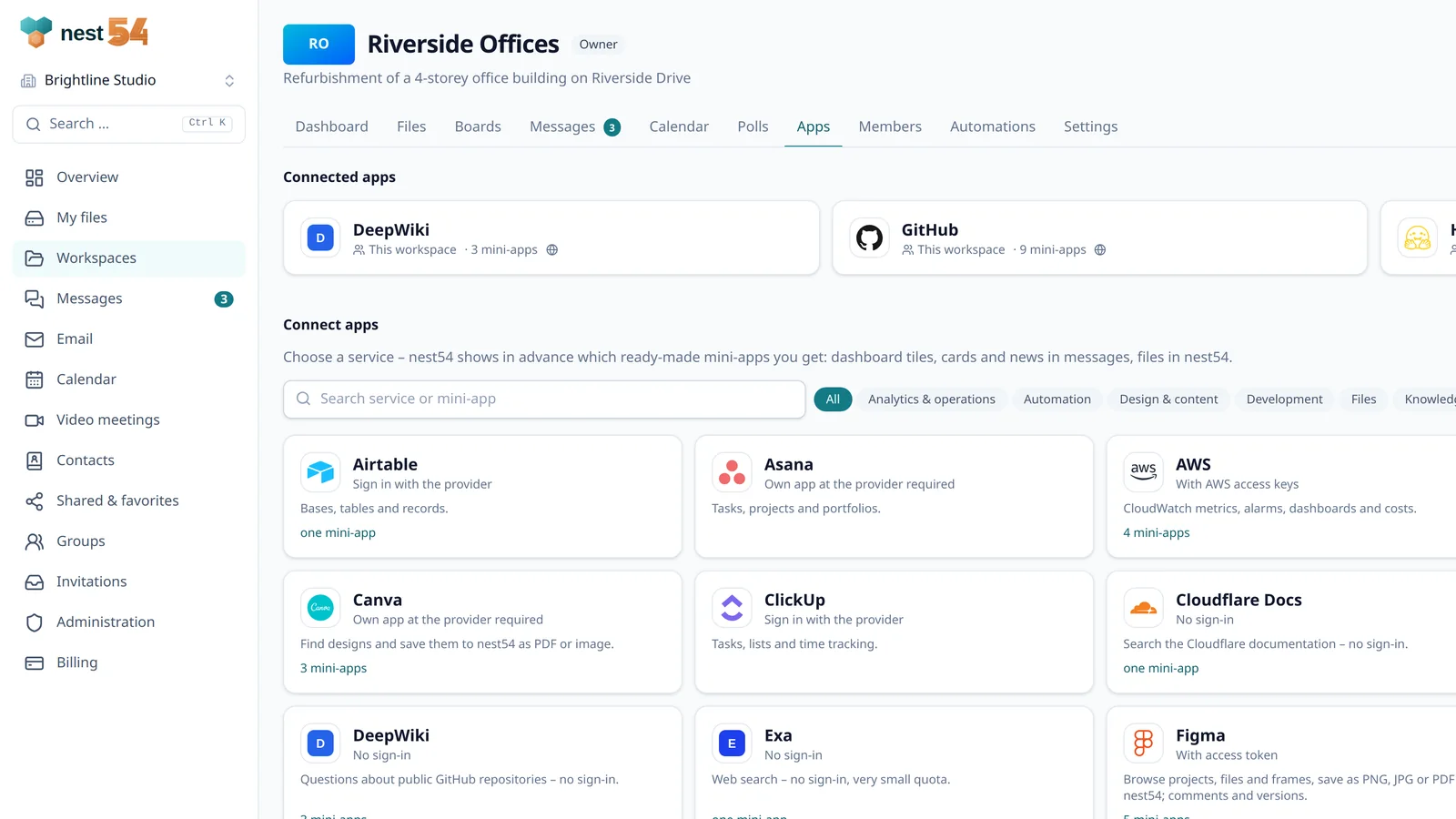
nest54 is a good fit for teams that want files, office, chat, video, calendar and tasks in one place without giving up Outlook right away. It is a weaker fit if you currently depend heavily on desktop Office, mobile apps or certified attestations. See Features and Security for an overview, and Pricing for the plans. What “digital sovereignty” means beyond data location is covered in Digital sovereignty for SMEs.
Frequently asked questions
Is it enough if Microsoft stores the data in the EU?
Data location matters, but it does not answer which law the provider is subject to. Under the US CLOUD Act, providers must disclose data under their control even if it is stored outside the United States.
Is the EU-US Data Privacy Framework still valid?
Yes. As of October 2026 the adequacy decision of 10 July 2023 remains in force. An appeal against the General Court’s judgment is pending, and after the Trump v. Slaughter ruling the European Data Protection Board asked the Commission for a close assessment.
Do I have to give up Outlook to use nest54?
No. nest54 connects to your Microsoft account, so you can read and send email in nest54 and sync calendars and contacts in both directions. The mailbox itself stays at Microsoft.
Sources
- 18 U.S. Code § 2713 – Required preservation and disclosure of communications and records – Legal Information Institute, Cornell Law School
- Commission d’enquête sur la commande publique – hearing of Microsoft, 10 June 2025 – French Senate
- Microsoft completes landmark EU Data Boundary – Microsoft
- Commission Implementing Decision (EU) 2023/1795 of 10 July 2023 (EU-US Data Privacy Framework) – EUR-Lex
- Judgment of the General Court of 3 September 2025, Latombe v Commission, T-553/23 – EUR-Lex
- Case C-703/25 P: Appeal brought on 31 October 2025 by Philippe Latombe – EUR-Lex
- EDPB Letter to the European Commission on US Supreme Court judgment Trump v. Slaughter (31 July 2026) – European Data Protection Board
- US Supreme Court just blew up EU-US Data Transfers – noyb
- Microsoft 365 and Office 365 plan options – Microsoft Learn
- Shared channels in Microsoft Teams (compliance) – Microsoft Learn
- Cloud Computing Compliance Criteria Catalog (C5) – Microsoft Learn